

Eco designer Aileen Woods creates art that reconnects people to the earth and to themselves.
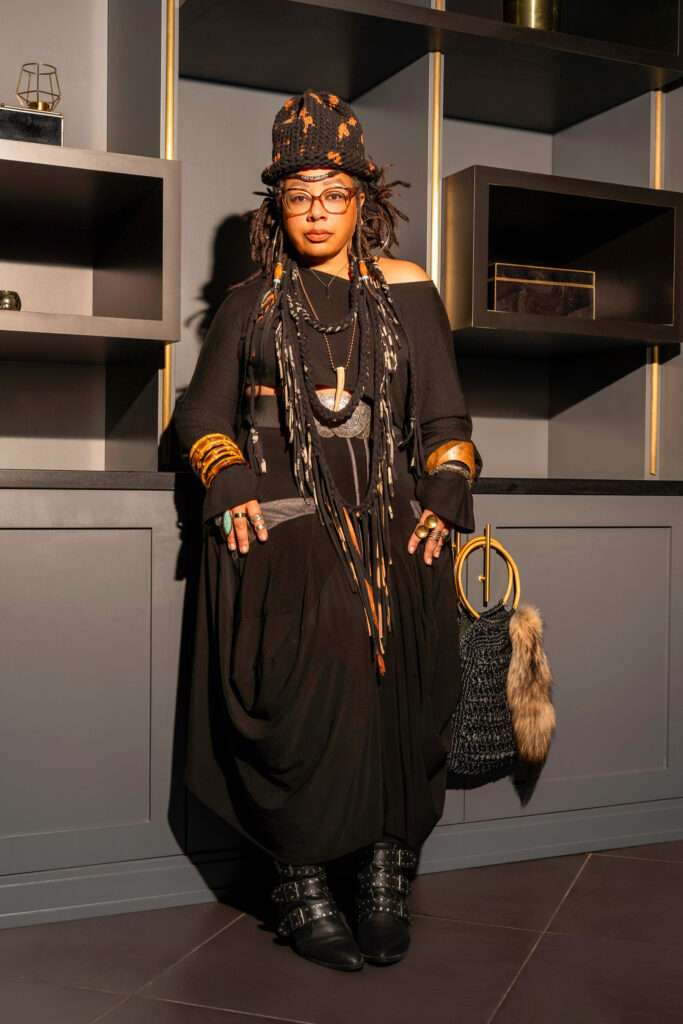
Aileen Woods is a trailblazer in the art of eco design. She is a textile artisan. A public artist. A biophiliac who sees the world through leaves, fibers, textures, and the quiet intelligence of nature itself. “When you spend time in nature, you realize nothing is disposable,” she beams. “Everything transforms into something else. My work is about bringing that same philosophy into design.”
Once you understand that, everything about her work makes sense.
Long before her work appeared inside Neiman Marcus, Aileen Woods already knew where she belonged.
Outside.
As a child, she spent hours in nature, turning over rocks, climbing trees, and studying the quiet rhythms of the natural world. “Nature was my safe place,” she says. “It kept me grounded.” For Woods, the outdoors was where she learned how to exist in the world. Adopted as a baby and growing up without a clear connection to her ancestry, she often felt disconnected from the question many people take for granted: Who am I, and where do I come from?
Nature became the place where that search quietly began. Years later, it would shape the foundation of her creative life.
Creating a Different Life
Woods began her design practice with a decision. “I wanted to make a way out of no way,” she says. “I wanted to create a life that felt good on the inside.”
About fourteen years ago, she started experimenting with small wearable pieces. The jewelry, accessories, and handcrafted designs drew her attention. At the time, she had no idea what direction her work would ultimately take. The early pieces look nothing like what she creates today. “My style has evolved tremendously,” she says. “I grew with my business.”
What began as experimentation deepened into a creative practice that helped her understand herself. “I discovered who I am through creating,” she says. “My creative practice has grown me up.” That process was largely intuitive.
Without a clear blueprint to follow, Woods began designing from instinct, pulling inspiration from the earth, natural textures, and materials that felt grounding and organic. Over time, her instinct evolved into a philosophy.
Today, she identifies herself first and foremost as an eco designer. Aileen is a textile artisan and public artist whose work centers on sustainability and the relationship between humans and the natural world.
Eco Design for the Planet and People
Nature remains the heartbeat of Woods’ design process. “I have a very intimate relationship with nature,” she says. That connection shows up everywhere in her work, from the natural fibers and organic textures she chooses to the sense of calm she hopes people feel when they encounter her pieces.
“I want people to feel grounded,” she explains. “That’s what the work does for me.” Her brand, Rustik Rich Designs, reflects that philosophy. Through handwoven textiles, sculptural accessories, and mixed-media art pieces, Woods transforms organic materials into work that feels earth-driven and quietly refined.
Many of the materials she uses come from circular design practices and repurposed fibers, natural elements, and biodegradable resources. “I love the circular model,” she says. “It’s about honoring materials instead of wasting them.”
Sometimes that means sourcing elements from global suppliers. Other times, it means finding inspiration much closer to home. In recent years, Woods began collecting driftwood from Midwest waterways and incorporating it into new designs. “I’m learning how to work with what’s here,” she says. “And I love it.”
The Neiman Marcus Moment
When Woods walked into Neiman Marcus St. Louis for the Black Creatives in the Lou designer showcase and saw her work displayed inside the store, the moment took a beat to sink in. “It was surreal,” she says. “I had to catch up to that reality.”
The exhibition, organized and curated by creative advocate Yolanda “Yoro” Newson, has become a powerful platform for artists across the region. For Woods, the experience was authentic. “The reactions were genuine,” she says. “People understood what I was trying to do.”
For an artist whose work is deeply personal and intuitive, that recognition meant everything. “It confirmed that my work belongs in public spaces,” she says.
A Community That Sees Her
Woods is quick to point out that her success is not something she built alone. “St. Louis sees me,” she says. The city’s creative community has shared and celebrated her work, encouraging her. And she does the same for her fellow artists. The cheerleading is soul-warming. “I know what it feels like to not have support,” she says. “So every little bit means everything.”
While larger creative markets may offer broader access to materials and manufacturing resources, Woods believes St. Louis offers something equally powerful: community.
“In the presence of scarcity, incredible creativity is born,” she says. The limitations become an invitation to innovate.
“In the presence of scarcity, incredible creativity is born.”
– Aileen Woods
The Circular Life
For someone who once felt disconnected from identity and belonging, Woods has created something remarkable for herself and others. Through her work, she creates spaces where people can reconnect with the earth inside themselves, with the quiet sense of groundedness she found in nature as a child.
Her perspective arrives at a moment when, across the fashion and design industries, conversations about sustainability are growing louder. Woods represents a mindset shift that understands design as a regenerative act. A blueprint for how creativity can coexist with responsibility.
Ultimately, in her hands, that philosophy becomes tangible.
Some call it eco design. Others call it slow fashion. You might call it circular thinking.
Aileen would probably just call it common sense.
Looking back, her journey was inevitable. The natural spaces that gave Aileen a sense of belonging and helped her understand herself now live in the art she creates. It reminds us that the path forward begins by returning to the earth beneath our feet.
She reflects, “When you design with the earth in mind, you start to realize you’re not just creating something beautiful. You’re protecting something that has to exist long after us.”

- I AM x DeShawn M. Bey: Confidence is the Dress Code - Thursday, March 5, 2026
- Making a Way: Eco Design Phenom Aileen - Thursday, March 5, 2026
- From Central VPA to Neiman Marcus: Afton Johnson - Thursday, March 5, 2026